
Research Projects
Fire Ecology and Management
Eastern Wildfire Network (EFNet)
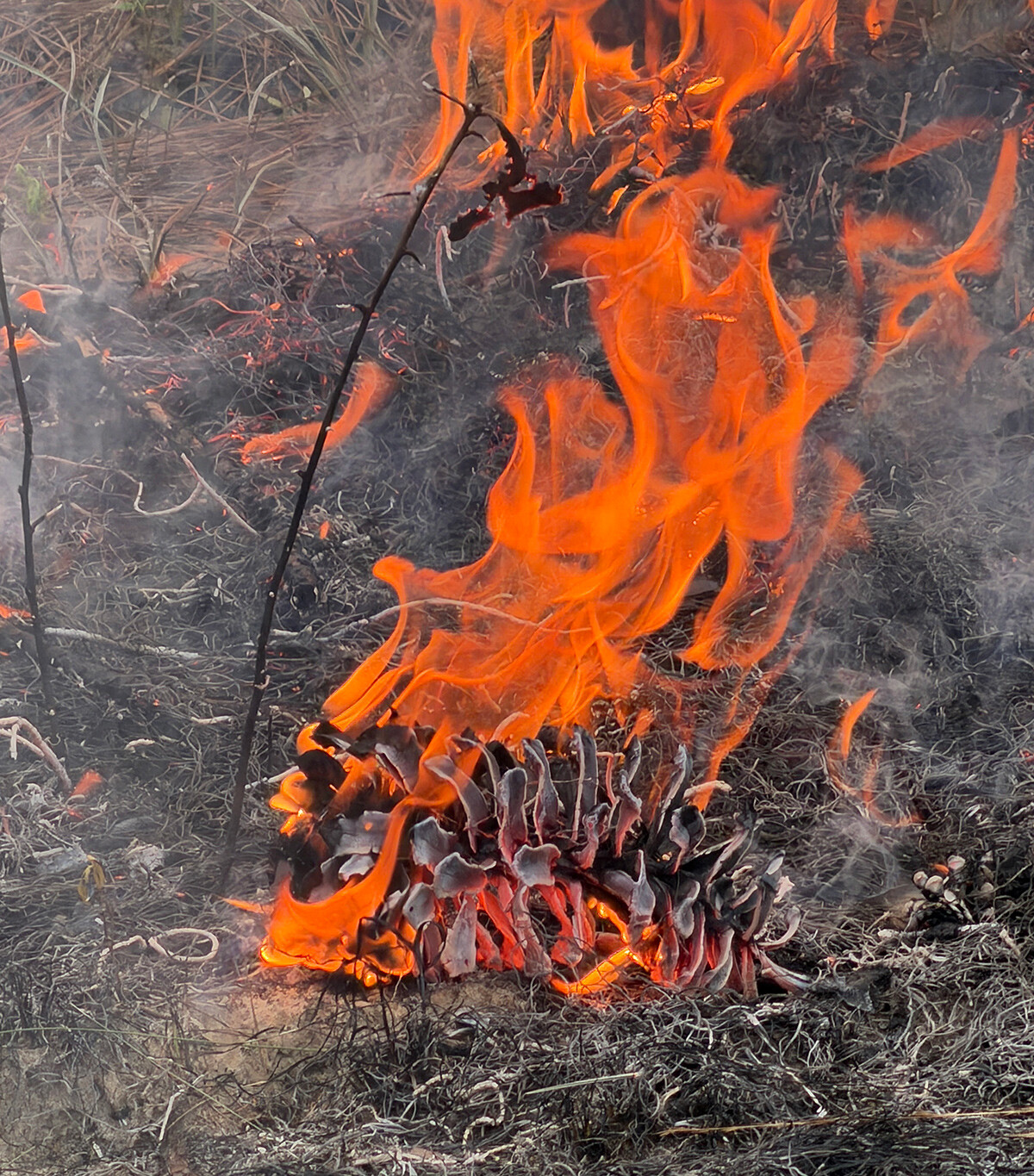
The Eastern Fire Network (EFNet) is a research and training network focused on catalyzing a transdisciplinary research agenda on wildfire in the eastern U.S. and developing a learning community for eastern wildfire that best informs science, policy, and management. We ask: (1) What is unique about eastern wildfire? (2) What are research opportunities to better understand future risks and impacts? (3) What are key data needs, gaps, or opportunities?
FUNDING EXAMPLES:
This research is funded through the U.S. National Science Foundation (NSF) Fire Science Innovations through Research and Education (FIRE) program, a collaboration among NSF, NASA, DOD SERDP/ESTCP and the Gordon and Betty Moore Foundation to advance wildland fire research.
Yu M, Riadi S, Sauda S, Holmes L, Smithwick EAH. 2026. Probabilistic assessment of PM2.5 and ozone co-occurring extremes under wildfire smoke in the contiguous United States. Environmental Science & Technology, https://doi.org/10.1021/acs.est.6c04403.
Wildfire, Ecosystems, and Climate Change
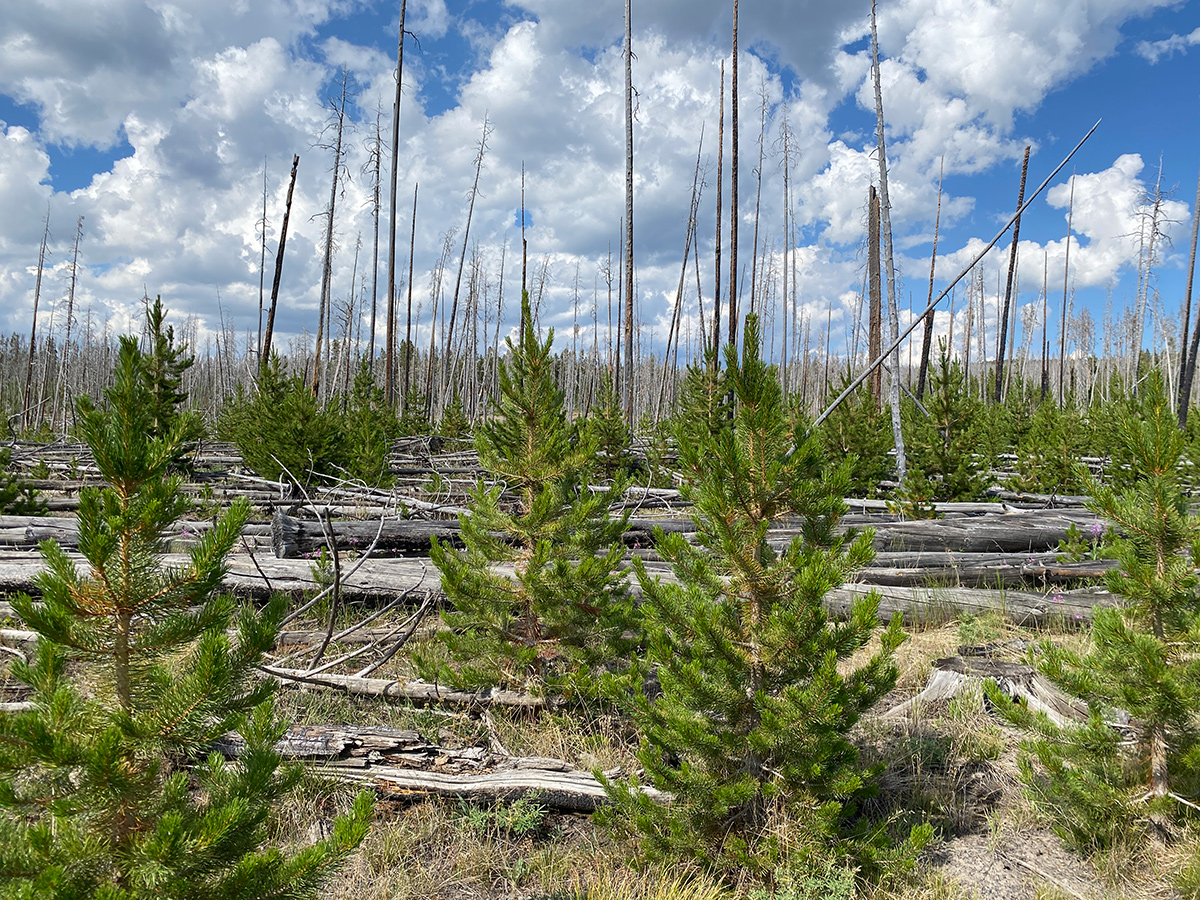
Some ecosystems, such as the Greater Yellowstone Ecosystem in the Sub-alpine Rocky Mountain region of the U.S., are adapted to severe, stand replacing wildfire that have occurred throughout the Quaternary. Together with our collaborators, our research, using both field research and landscape modeling, has shown that these forested ecosystems are resilient, in terms of carbon storage and nutrient cycling, to these extreme events, largely returning to pre-fire conditions prior to the next fire. However, climate change is making these rare events more frequent. Our research has demonstrated a 10-fold increase in the pace of these extreme fire events. Now, work is focused on providing guidance to land managers about how to support forest resilience through spatial planning.
SELECTED PRODUCTS:
- Peeler JL*, Smithwick EAH. 2021. Interactions between landscape and local factors inform spatial action planning in post-fire forest environments. Landscape Ecology 36(12): 3523-3537, 10.1007/s10980-021-01325-4.
- Peeler JL*, Smithwick EAH. 2020. Seed source pattern and terrain have scale-dependent effects on post-fire tree recovery. Landscape Ecology 35 (9): 1945-1959. https://doi.org/10.1007/s10980-020-01071-z
- Peeler JL*, Smithwick EAH. 2018. Exploring invasibility with species distribution modeling: How does fire promote cheatgrass (Bromus tectorum) invasion within lower montane forests?Diversity & Distributions. 00:1–13. https://doi.org/10.1111/ddi.12765
- Smithwick EAH. 2016. Build social costs into wildfire risks. Nature (Correspondence) 535 (7611): 231. doi:10.1038/535231b
- Keane RE, McKenzie D, Falk DA, Smithwick EAH, Miller, C., Kellogg, L-K. B. 2015. Representing climate, disturbance, and vegetation interactions in landscape models. Ecological Modelling 309-310: 33-47. doi:10.1016/j.ecolmodel.2015.04.009
- Keane RE, Loehman R, Clark, J, Smithwick EAH, Miller C. Exploring interactions among multiple disturbance agents in forest landscapes: simulating effects of fire, beetles, and disease under climate change. Ch.8, pp 201-231, in Simulation Modeling of Forest Landscape Disturbances, Perera A., Remmel, R. and Buse L., eds., Springer International Publishing Switzerland, doi: 10.1007/978-3-319-19809-5_8.
- McLauchlan KK, Higuera PE, Gavin DG, Perakis SS, Mack MC, Alexander H, Battles J, Biondi F, Buma B, Colombaroli D, Enders S, Engstrom DR, Hu FS, Marlon JR, Marshall J, McGlone M, Morris JL, Nave LE, Shuman BN, Smithwick E, Urrego DH, Wardle DA, Williams CJ, Williams JJ. Reconstructing disturbances and their biogeochemical consequences over multiple timescales. BioScience 64(2): 105-116.
- Smithwick EAH. 2011. Pyrogeography and biogeochemical resilience, pp143-164 inThe Landscape Ecology of Fire, eds. by D. McKenzie, D. Falk, C. Miller, Springer.
- Westerling AL, Turner MG, Smithwick EAH, Romme WH, Ryan MG. 2011. Continued warming could transform Greater Yellowstone fire regimes by mid-21st Century, Proceedings of the National Academy of Sciences 108: 13165-13170. doi: 10.1073/pnas.1110199108
- Turner MG, Romme WH, Smithwick EAH, Tinker DB, Zhu J. Variation in aboveground cover influences soil nitrogen availability at fine spatial scales following severe fire in subalpine conifer forests. Ecosystems 14(7):1081-1095. doi: 10.1007/s10021-011-9465-3
- Smithwick EAH,Westerling AL, Turner MG, Romme WH, Ryan MG. Vulnerability of Landscape Carbon Fluxes to Future Climate and Fire in the Greater Yellowstone Ecosystem.” In: Questioning Greater Yellowstone’s Future: Climate, Land Use, and Invasive Species. Proceedings of the 10th Biennial Scientific Conference on the Greater Yellowstone Ecosystem. October 11–13, 2010, Mammoth Hot Springs Hotel, Yellowstone National Park. C. Andersen, ed., 131–134. Yellowstone National Park, WY, and Laramie, WY: Yellowstone Center for Resources and University of Wyoming William D. Ruckelshaus Institute of Environment and Natural Resources
- Turner MG, Smithwick EAH, Tinker DB, and Romme WH. Variation in foliar nitrogen and aboveground net primary production in young postfire lodgepole pine. Canadian Journal of Forest Research-Revue Canadienne De Recherche Forestiere 39:1024-1035. https://doi.org/10.1139/X09-029
- Smithwick EAH, Kashian DM, Ryan MG, and Turner MG. Long-term nitrogen storage and soil nitrogen availability in post-fire lodgepole pine ecosystems. Ecosystems 12:792-806. http://dx.doi.org/10.1007/s10021-009-9257-1
- Smithwick EAH, Ryan MG, Kashian DM, Romme WH, Tinker DB, and Turner MG. Modeling the effects of fire and climate change on carbon and nitrogen storage in lodgepole pine (Pinus contorta) stands. Global Change Biology 15:535-548. doi: 10.1111/j.1365-2486.2008.01659.x
- Schoennagel T, Turner MG, and Smithwick EAH. Landscape heterogeneity following large fires: insights from Yellowstone National Park, USA. International Journal of Wildland Fire 17: 742-753. doi: 10.1071/WF07146
- Metzger KL, Smithwick EAH, Tinker DB, Romme WH, Balser TC, and Turner MG. Influence of coarse wood and pine saplings on nitrogen mineralization and microbial communities in young post-fire Pinus contorta. Forest Ecology and Management 256:59-67. https://doi.org/10.1016/j.foreco.2008.03.043
- Turner, MG, Smithwick EAH, Metzger KL, Tinker DB, and Romme WH. Inorganic nitrogen availability following severe stand-replacing fire in the Greater Yellowstone Ecosystem, inaugural paper, Proceedings of the National Academy of Science 104 (12): 4782-4789. doi: 10.1073/pnas.0700180104
- Smithwick EAH. 2006. Editorial: Role of microbial communities in mediating ecosystem response to disturbance, Special Issue in Plant and Soil 289:1-3. doi:10.1007/s11104-006-9084-5
- Smithwick EAH, Mack MC, Turner MG, Chapin III FS, Zhu J, Balser TC. 2005. Spatial heterogeneity and soil nitrogen dynamics after severe fire in a black spruce (Picea mariana) forest, Alaska: Distinct controls at different scales. Biogeochemistry 76: 517-537. doi: 10.1007/s10533-005-0031-y
- Smithwick EAH,Turner MG, Mack MC, Chapin III, FS. Post-fire soil N cycling in northern conifer forests affected by severe, stand-replacing wildfires. Ecosystems 8: 163-181. doi: 10.1007/s10021-004-0097-8
- Smithwick EAH,Turner MG, Metzger KL, Balser TC. 2005. Variation in NH4+ mineralization and microbial communities with stand age in lodgepole pine (Pinus contorta) forests, Yellowstone National Park (USA). Soil Biology and Biochemistry 37: 1546-1559. doi: 10.1016/j.soilbio.2005.01.016
- Korontzi S, Ward DE, Susott RA, Yokelson RJ, Justice CO, Hobbs PV, Smithwick EAH, Hao WM. 2003. Seasonal variation and ecosystem dependence of emission factors for selected trace gases and PM2.5 for southern African savanna fires. Journal of Geophysical Research 108(D24), 4758. doi: 1029/2003JD003730
- Hoffa EA (maiden name), Ward DE, Hao WM, Susott RA, Wakimoto RH. 1999. Seasonality of carbon emissions from biomass burning in a Zambian savanna. Journal of Geophysical Research 104: 13,841 – 13,853. doi: 10.1029/1999JD900091
FireScapes of the MidAtlantic
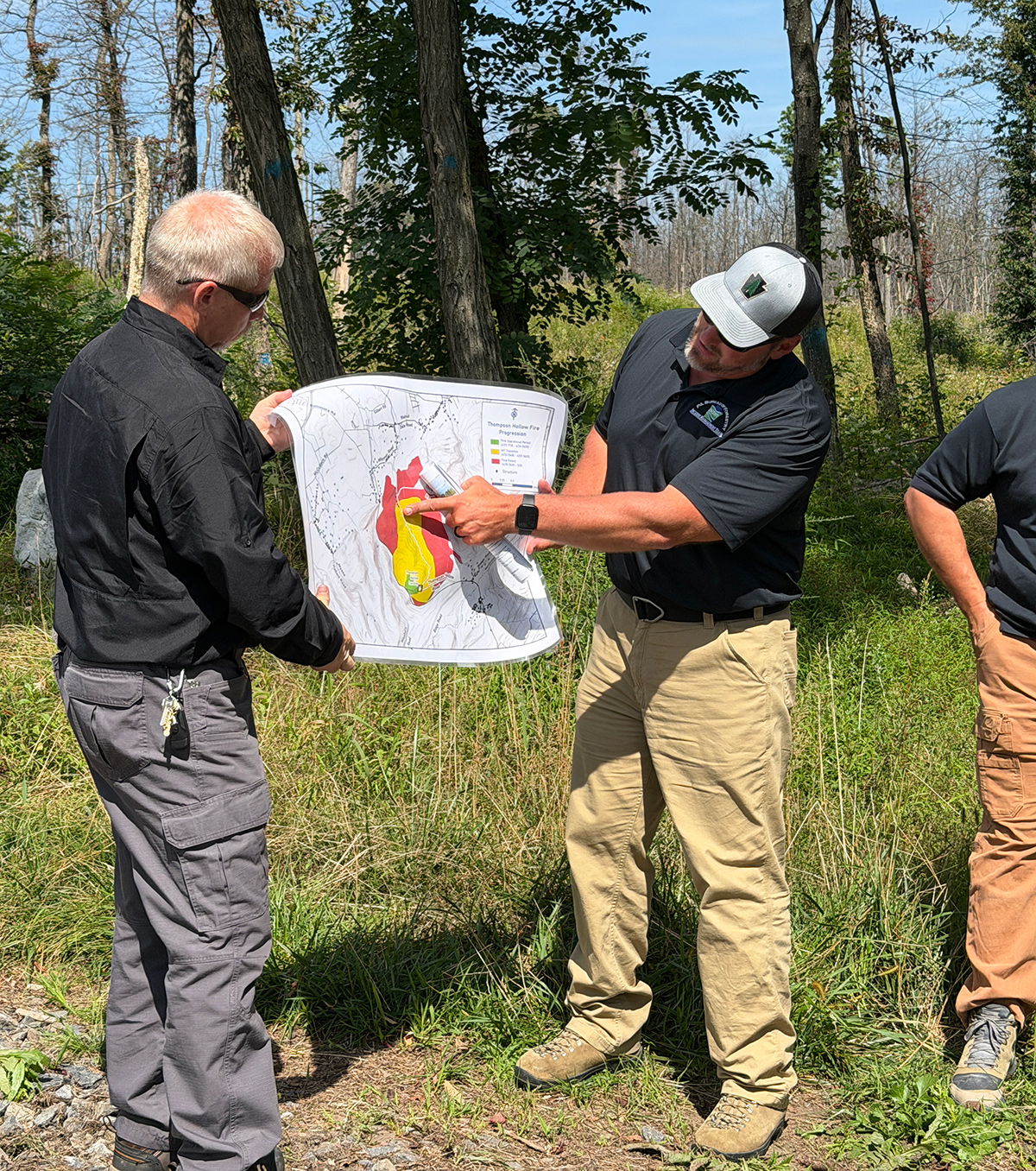
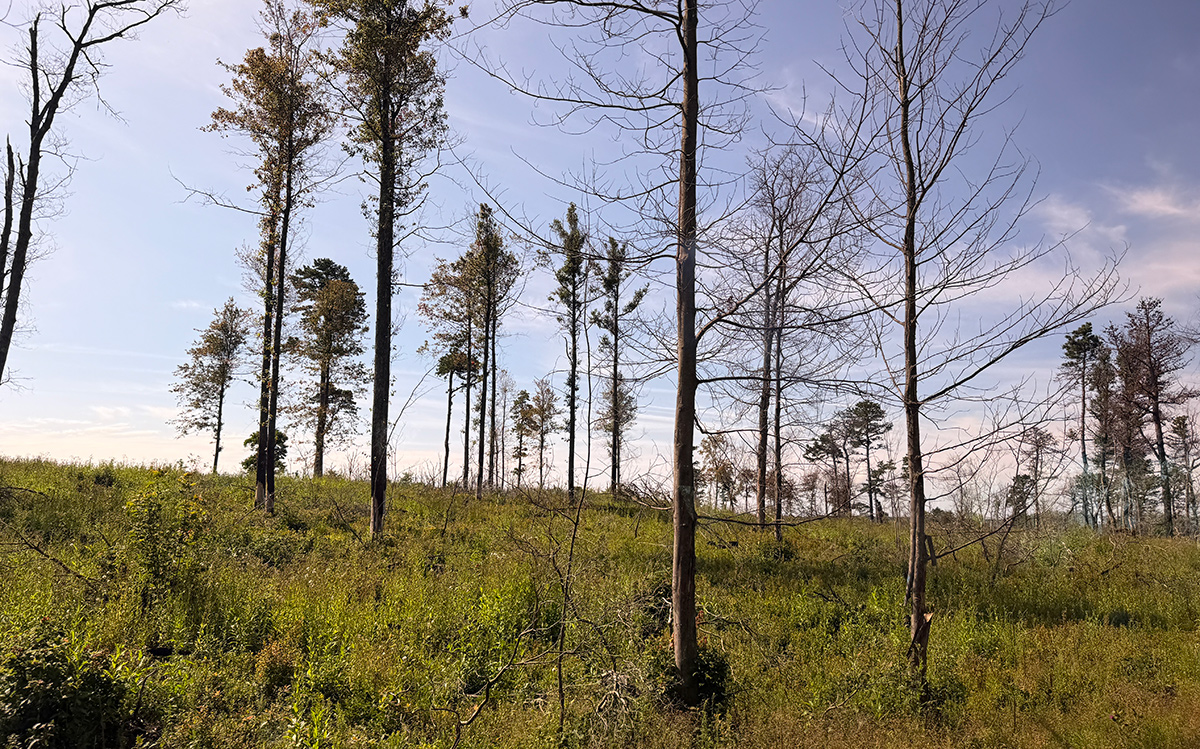
The social barriers and opportunities of prescribed fire management practices in the mid-Atlantic region are unknown. We hypothesized that there are mismatches between community perceptions of prescribed fire operations in the mid-Atlantic U.S. and the realities of its current and potential use in landscape management, but that these mismatches varied across the region between places with recent (Pennsylvania (PA)) and long-term (New Jersey (NJ)) active management programs. We used interdisciplinary, mixed-method approaches including trailhead surveys, focus groups, field measurements, simulation modeling, and environmental cost-benefit analysis. The goal was to triangulate the interactions among fire effects on ecosystems, community perceptions of benefits and concerns about prescribed fire, and manager perceptions of barriers and opportunities for putting managed fire safely back on the landscape.
SELECTED PRODUCTS:
- FINAL REPORT – Smithwick, E.A.H., M. Kaye, A. Taylor, P. Newman, K. Zipp, H. Wu. 2020. Firescapes in the mid-Atlantic: Mismatches between social perceptions and prescribed fire use
- WPSU Outreach and teaching videos; provided to managers and distributed on North Atlantic Fire Science Exchange Learning Network twitter feed.
- Watch “Firescapes in the mid-Atlantic – A research project” (vimeo)
- Watch “Firescapes in the mid-Atlantic – The importance of community involvement” (vimeo)
- Wu H, Miller ZD, Wang R, Zipp K, Newman P, Shr Y-H, Dems CL, Taylor A, Kaye M, Smithwick EAH. 2022. Public and management perspectives about prescribed fire in the Mid-Atlantic, United States. Journal of Environmental Management 322: 116100 https://doi.org/10.1016/j.jenvman.2022.116100.
- Dems CL, Taylor AH, Smithwick EAH, Krey JK, Kaye Mw. 2021. Prescribed fire alters structure and composition of a mid-Atlantic oak forest up to eight years after burning. fire ecol17(10). doi: 10.1186/s42408-021-00093-5
- Miller ZD, Wu H, Zipp K, Dems CL, Smithwick EAH, Kaye M, Newman P, Zhao A, Taylor A. 2020. Hunter and non-hunter perceptions of costs, benefits and likelihood of outcomes of prescribed fire in the mid-Atlantic region. Society & Natural Resources33 (10): 1321-1327. doi: 10.1080/08941920.2020.1780359
- Dems C, Taylor AH, Smithwick EAH, Kreye J, Kaye MW. 2021. Prescribed fire alters structure and composition of a Mid-Atlantic oak forest up to eight years after burning. Fire Ecology 17 (10), https://doi.org/10.1186/s42408-021-00093-5 .
- Zhao A, Taylor AH, Smithwick EAH, Kaye M, Harris L. 2021. Simulated fire regimes favor oak and pine but affect carbon stocks in mixed oak forests in Pennsylvania, U.S.A. 2021. Forest Ecology and Management 494: 119332 https://doi.org/10.1016/j.foreco.2021.119332
- Smithwick EAH, Taylor AH, Kaye MW, Zipp K, Wu H, Miller ZD, Shr Y-H, Zhao A, Dems C, Newman P. Manager perspectives: barriers and opportunities of prescribed fire in the mid-Atlantic, in prep.
- Smithwick EAH. 2010. Pyrogeography: Lessons for future northeastern U.S. landscapes. Penn State Environmental Law Review 18(2): 101-121.
FUNDING EXAMPLES:
- USDI Joint Fire Sciences Program 16-1-02-5. Firescapes in the mid-Atlantic: mismatches between social perceptions and prescribed fire use. Principal Investigator, 08/01/2016- 07/31/2020, ($327,726)
- USDI Joint Fire Science Program. Climate, fire and carbon: tipping points and landscape vulnerability in the Greater Yellowstone Ecosystem. Principal Investigator, 7/1/09- 12/31/10, ($140,653)
- Penn State Institute of Energy and Environment Seed Grant. Landscapes of fire and people: how climate, human values, and shifting ecologies will influence mid-Atlantic forest management. Principal Investigator, 3/15/16 – 6/30/15, ($24,737)